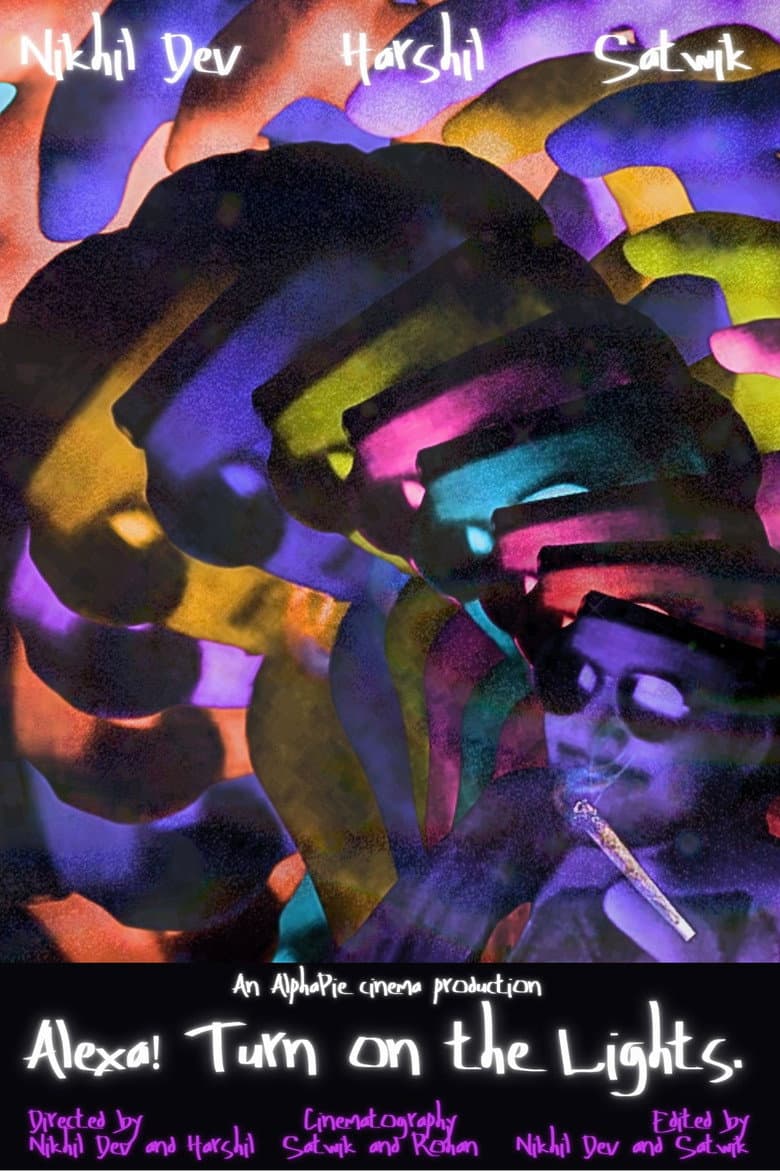
Five days. That is how long Nikhil Dev's "Alexa! Turn on the Lights." has been in the world, and already the ten-minute comedy has become one of the most talked-about curiosities in Tollywood's crowded independent space. Released on October 5, 2026, the film carries a premise so slight and so absurd that it practically dares you to take it seriously: a man, a smart speaker, and a command that refuses to land. The title itself is the punchline, and the film knows it.
Dev wears three hats here. He directs, he writes, and he steps in front of the camera as a character who shares his name, a choice that signals early on that this is personal, handmade filmmaking rather than a studio product. Beside him sits HARSHIL, credited simply as Harshil, and rounding out the trio is Satwik Kruttiventi as the memorably named Leather jacket guy, a character whose wardrobe apparently arrived before his personality did. Three performers, one room, ten minutes. The geometry of the thing is almost theatrical.
What is striking about this release is how completely it commits to its own smallness. There is no attempt to expand a sketch into a saga. The entire runtime is shorter than a lunch break, and the single-line overview offers only three words in all caps: "I THINK WE SHOULD ROLL." That is not a logline so much as a provocation, a scrap of dialogue flung at the audience and left there to echo. Anyone hoping for plot summary will have to buy a ticket, or in this case, press play.
The premise of a voice assistant that will not obey is hardly new territory. Filmmakers have spent years mining the gap between what we ask our devices to do and what they actually do, usually with apocalyptic results. Dev appears to have taken the opposite route. Instead of horror, he has opted for comedy, and instead of global catastrophe, he has shrunk the stakes down to a single domestic frustration. The smart home becomes a stage for a very human kind of helplessness: the feeling of shouting into a void and hearing nothing back. It is a joke anyone with a Wi-Fi connection understands instantly, and it is the reason a ten-minute film with no stars and no marketing budget has found its way into conversations.
Telugu comedy has always had an appetite for the domestic and the absurd, often in the same breath. The genre's best-loved moments frequently involve ordinary people losing arguments with ordinary objects. Dev seems to be working in that tradition, though with a distinctly modern instrument. The device in question is not a mother-in-law or a landlord, but a piece of plastic that listens, or claims to. The satire is gentle rather than savage, which befits the film's minuscule scale. This is not a work interested in diagnosing the age of surveillance. It simply wants to watch a man ask, over and over, for a light to come on.
Where the film's ambitions become genuinely interesting is in its disregard for conventional polish. Dev's decision to play a version of himself, and to give his lead actor a credit indistinguishable from his own name, blurs the line between performer and creator in a way that suggests the film is as much a calling card as a story. In the crowded ecosystem of Telugu shorts vying for attention, personality is currency, and a title like this one does more marketing in seven words than most posters manage in a full campaign. It lodges in your head. You start saying it out loud.
The three-person ensemble deserves mention precisely because there are so few of them. HARSHIL and Kruttiventi have the unglamorous task of building chemistry in a film shorter than most audition tapes. Kruttiventi's credit as Leather jacket guy hints at a comedic archetype delivered with a straight face, the sort of role that exists to be laughed at and, if the timing is right, quietly stolen. Whether these performers get room to breathe across ten minutes is the central craft question the film raises, and it is one Dev, as director, had to answer quickly.
As for where all this lands commercially, there is nothing to report. No figures are circulating, no tracking exists, and the film's own metadata carries a rating of zero out of ten, which is less a judgment than a reflection of sample size. In the world of independent shorts, that number means almost nothing. What matters is that five days in, people are still typing out that ridiculous, perfect title and pressing search.
"Alexa! Turn on the Lights." may be a small thing, three people and a mechanical voice and a light that will not switch on. But smallness, done with conviction, has a way of traveling. If Dev's film proves anything in its brief runtime, it is that the joke you cannot stop repeating is often the one worth telling.