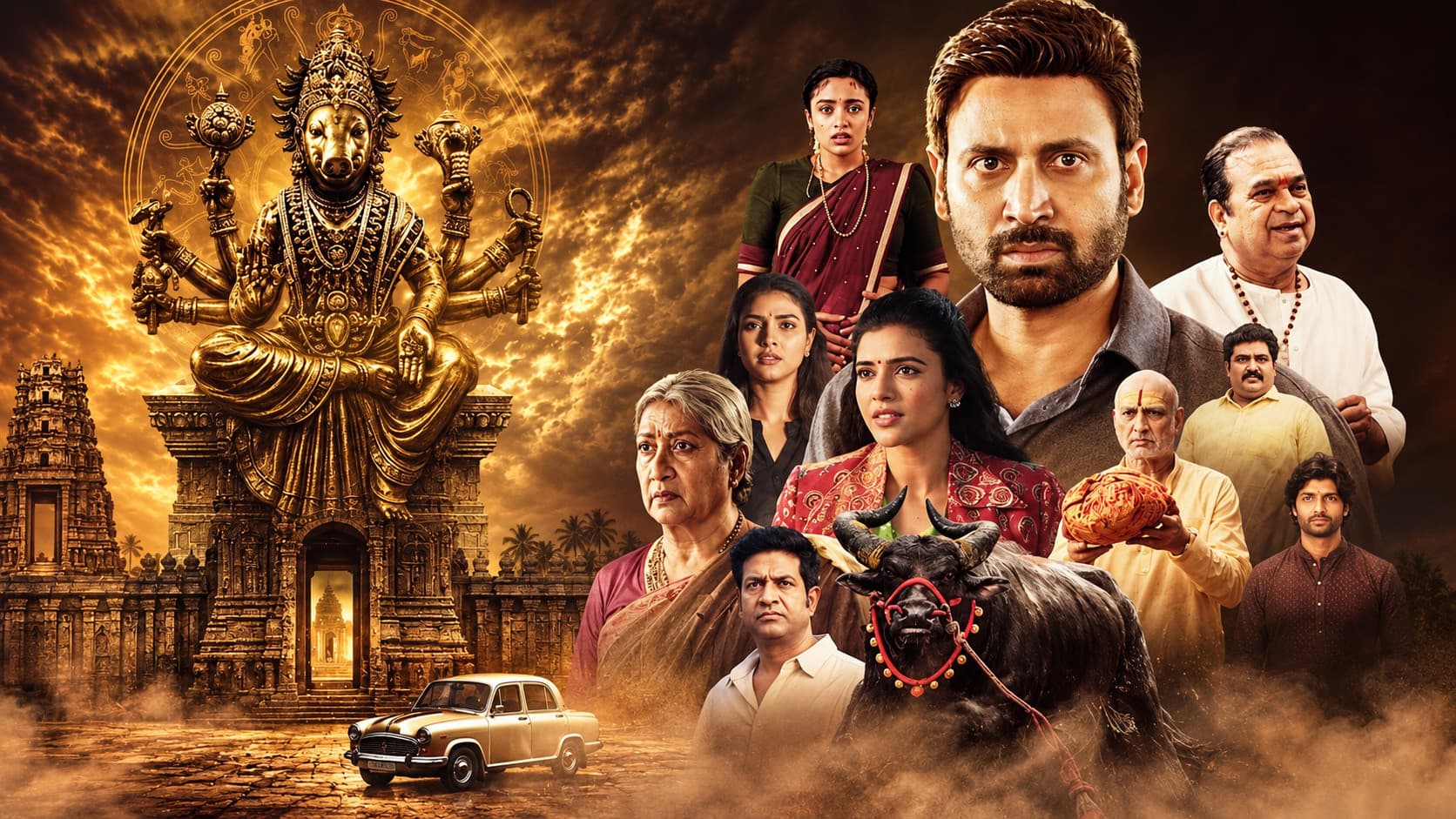
There is a particular kind of silence that hangs over ancient temple towns - a silence that feels less like the absence of sound and more like the presence of something waiting. That is the atmosphere Santosh Jagarlapudi appears to have bottled for Mahendragiri Varahi, a film that arrives in theatres today carrying the weight of a title most Telugu audiences have heard whispered but never quite seen explored on screen.
At its centre is Siddharth, played by Sumanth, a man who has built his identity around disbelief. He is an atheist, a skeptic, the sort of protagonist who walks into a sacred space with a smirk and walks out with questions he cannot answer. The ancient Varahi temple at Mahendragiri becomes the crucible for that transformation. What begins as curiosity - or perhaps something closer to intellectual arrogance - unfolds into a journey that the film's own synopsis describes as a confrontation with forces beyond understanding. Faith, destiny, the supernatural: these are not small themes, and Jagarlapudi seems uninterested in treating them as decoration.
The casting suggests as much. Sumanth has spent much of his career choosing scripts that prioritise interiority over spectacle, and Siddharth's arc - a man forced to dismantle his own certainties - fits that instinct. Around him, the film assembles a genuinely intriguing ensemble. Meenakshi Goswami, Aishwarya Rajesh, and Malvika Nair bring a range of presence that suggests the women in this story are not ornamental. Manju Bhargavi's name alone carries decades of cinematic memory, while Brahmanandam's inclusion hints that the film understands the value of tonal breathing room even within a mystery-thriller framework. Rajeev Kanakala and Rajsekhar Aningi round out a cast that feels deliberately assembled rather than randomly stacked.
What makes Mahendragiri Varahi particularly interesting is its positioning. Telugu cinema has spent the last several years oscillating between larger-than-life mass entertainers and intimate, rooted dramas. A fantasy-thriller-mystery hybrid anchored in a real sacred site sits somewhere in between - ambitious enough to promise scale, specific enough to feel personal. The film is not chasing a pan-Indian aesthetic or a CGI-heavy mythological universe. It is, at least on paper, a story about one man and one place.
The release timing is worth noting. September 11 arrives without the clutter of a festival weekend or a crowded box-office corridor, which gives the film room to find its audience on its own terms. There is no runtime listed in the official metadata - an unusual omission that only adds to the air of mystery surrounding the project. Whether that is a deliberate marketing choice or simply an oversight, it fits a film that seems to want audiences to discover it rather than have it fully explained to them in advance.
Director Santosh Jagarlapudi is not a name that immediately conjures a signature style, and that may be to his advantage here. A story like this lives or dies on restraint - on the director's willingness to let dread accumulate rather than announce itself. The temple setting offers natural texture: stone, shadow, ritual, and the unspoken rules that govern spaces considered sacred. If Jagarlapudi trusts those elements, Mahendragiri Varahi could offer something rare in Telugu cinema: a supernatural thriller that respects its audience's intelligence.
As of this morning, the film holds a 0/10 rating on TMDb, which tells us nothing beyond the fact that almost no one has seen it yet. Ratings at this stage are placeholders, not verdicts. What matters is whether the film delivers on the promise of its premise - a skeptic's descent into belief, or at least into uncertainty. That is a universal story, and it is one that Telugu audiences have shown a growing appetite for when it is told with conviction.
Mahendragiri Varahi opens today across Telugu-speaking markets. Whether it becomes a word-of-mouth discovery or a quiet footnote will depend on how honestly it treats its central question: what happens when a man who believes in nothing stands before something that believes in him?