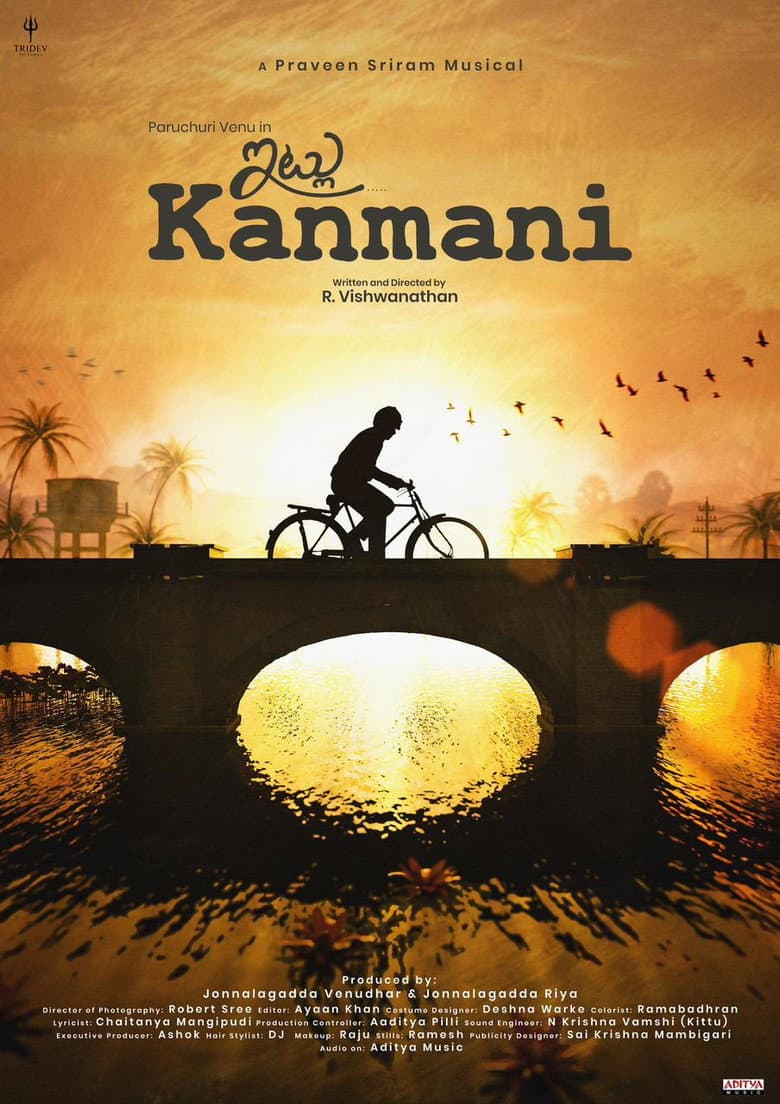
The air in the theater felt thick with anticipation. Not the nervous buzz of a blockbuster premiere, but something quieter, more intimate. The kind of hush that falls when a story promises to be personal. That was the mood on July 26, when Itlu Kanmani quietly slipped into release, offering a 50-minute slice of life that refuses to leave you. In a landscape dominated by high-octane spectacle, director Ramachandran Vishwanathan has delivered a tender, lyrical meditation on grief, ambition, and the silences that speak louder than words.
At its heart, Itlu Kanmani is a film about running away. Rohith, played with raw vulnerability by Paruchuri Venu, is a young man who had once dreamed in frames and sequences - a filmmaker in the making. But life, as it often does, rewrote his script. He abandons his celluloid aspirations to become a full-time caregiver for his ailing father. There’s no melodrama in this sacrifice; Vishwanathan renders it as a quiet, grinding reality. We see Rohith in the mundane rituals of care - the medicine schedules, the silent meals, the unspoken weight of duty.
Then comes the sudden death. It’s a jolt, not a crescendo. And in the aftermath of that loss, Rohith discovers something unexpected. The film cleverly pivots from a mournful drama into a mystery, but not one of stolen jewels or conspiracy. This is a mystery of the heart. Fragments of his father’s past begin to surface - a name, a photograph, a melody. Rohith finds himself haunted by questions he never thought to ask when it mattered. Why did his father, a man he thought he knew, harbor such secrets? What dreams were deferred, and what promises were broken?
This is where Itlu Kanmani finds its pulse. It’s a story about the stories we never tell our children, and the cost of that silence. E. RaviShankar Reddy delivers a poignant performance as the father, Ramakrishna, even if his presence is largely felt through memory and flashback. The film suggests that a parent’s life is a vast, uncharted continent, and children often only see the coastline. As Rohith digs deeper, the narrative slowly peels back the layers of his father's hidden life, revealing a world of music and a love that was left unfinished.
The title itself, Itlu Kanmani, translates to "Here, Kanmani" - an endearing, affectionate address. It’s a phrase that hints at a love story, and in many ways, this is one. But it’s not the straightforward romance you might expect. It’s a love story between a son and a father, and between a man and the dream he left behind. The music becomes a character in itself, a spectral thread that connects Rohith to the man his father used to be. As Rohith listens to old recordings and finds hidden sheet music, he realizes that his father’s greatest passion was not something that was taken away, but something that was voluntarily sacrificed for family.
Enter Chaitra, played with gentle grace by Thrayu Thirunagari. She is a compassionate doctor who becomes Rohith’s emotional anchor. While her role fits the "supportive presence" archetype, Thirunagari gives her a grounded intelligence. She doesn't solve Rohith’s problems; she simply sits with him in his confusion. Their conversations are whispered, light on exposition, and heavy on the kind of banter that feels real.
"Some dreams never truly disappear," Chaitra tells Rohith in one pivotal scene, a line that carries the film’s thesis. "They only wait for the right person to continue them."
Those words linger. Because the film’s real tension isn’t about solving a mystery, but about whether Rohith will have the courage to look at the truth staring back at him. He is a filmmaker who stopped making films. Yet, as he pieces together his father’s past, we watch him begin to see the world with a director’s eye again. He is framing shots of his father’s old room, listening to the rhythm of his hometown, noticing the details he had previously ignored. He is, unconsciously, making a film.
Rashmitha Rao Kommaragiri as the titular Kanmani is a spectral, yet magnetic, presence. She represents the "what if" of the past - the beautiful risk that was never taken. Her scenes, though brief, hold a melancholic weight, leaving an impression that explains so much about Ramakrishna’s reserved nature. Penumarthi Krishna, in a supporting role, rounds out the cast with a sense of community that feels distinctly rooted in the Telugu landscape.
Vishwanathan’s direction is notably assured, especially for a film of this intimate scale. He doesn’t rush the pacing, allowing the 50-minute runtime to breathe. There is a languid, almost meditative quality to the editing, which could frustrate viewers expecting a conventional melodrama with loud catharsis. Instead, the emotional payoff arrives in a final act that is as subtle as it is devastating. Rohith must decide: bury the past again and return to his comfortable grief, or confront the truth and, in doing so, pick up the camera he left behind for good.
Itlu Kanmani isn't a film about a father’s secret crime or a hidden fortune. It’s about the discovery that our parents were once young, with their own wild ambitions and broken hearts. It asks a profoundly uncomfortable question: what do we owe the dreams of those who came before us?
Without giving away the final frames, the film suggests that legacy isn’t about inheritance. It’s about continuation. It is a delicate, bittersweet showcase for Venu, who carries the emotional burden with aching authenticity, and a gentle reminder that while we cannot go back to ignite the dreams of those we have lost, we can find the courage to start our own engines. For a mid-year release with little commercial fanfare, Itlu Kanmani proves to be one of the most quietly moving Telugu films of 2026. It is a story that waits, patiently, for the right person to find it - and that person might just be you.