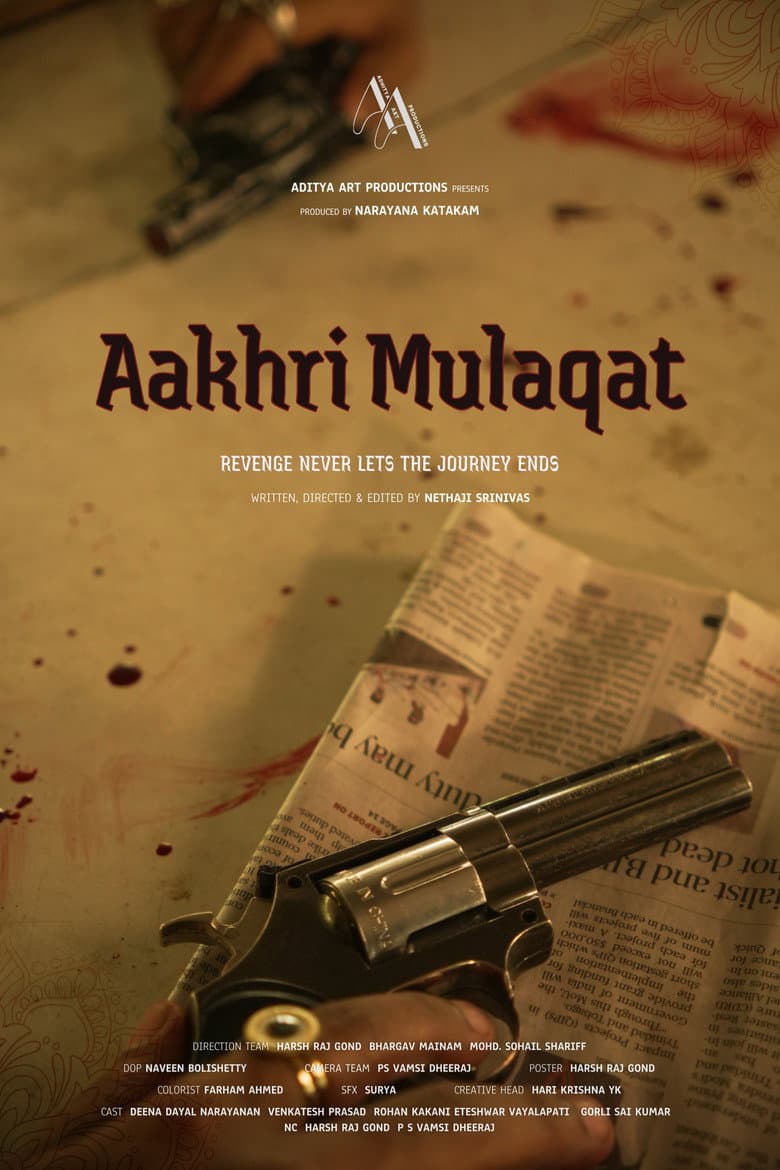

The rain in Nethaji Srinivas's Aakhri Mulaqat never quite washes anything clean. It falls over a city where a photojournalist named Aravind is chasing something far more dangerous than a headline: an illegal racket pushing fake antibiotics into the hands of people who cannot afford to ask questions. Around him, two rival gangs circle each other, their feud fuelled by greed and revenge, and by the time the credits roll, that quiet unease has settled into something closer to dread.
Released on October 15, 2026, the Telugu crime thriller runs just 27 minutes - a length that has raised eyebrows among audiences used to sprawling gangland dramas. But that brevity is the point. Aakhri Mulaqat - the title translates, fittingly, to "The Last Meeting" - works in a register closer to a short film, compressing its twin plots into a lean, relentless piece that wastes no time announcing itself.
Srinivas, directing his own script, structures the film around two parallel engines. On one side is Aravind (NC), a photojournalist whose investigation into the fake antibiotics trade pulls him into rooms where a camera is the least welcome object in sight. On the other, Hameed (Venkatesh Prasad) and Bashir (Rohan Kakani) anchor the gangland thread, their rivalry escalating with the kind of mechanical inevitability that suggests violence is less a choice than a habit. Deena Dayal Narayanan plays Aman, Eteshwar Vayalapati appears as Ferooz, Harsh Raj Gond is Sameer, and Gorli Sai Kumar steps in as Inspector Vikram Kumar, with P S Vamsi Dheeraj completing the ensemble as a constable.
What makes the film's premise sting is how ordinary its villainy is. Fake medicine is not the stuff of gaudy crime spectaculars; it is paperwork, supply chains, and someone deciding that a life is worth less than a margin. The film's official logline captures the machinery at work: as violence brings one conflict to an end, it merely sets the stage for another, in a cycle that never truly ends. That line could serve as the thesis of the entire piece. Here, resolution is never resolution - it is a pause.
The 27-minute runtime cuts both ways. It denies viewers the slow-burn pleasure of watching motives unfurl over hours, but it also keeps the film honest. Every scene is required to justify its presence. Supporting players - Inspector Vikram Kumar, Constable, the various men caught between factions - register as fragments rather than fully drawn portraits, which feels appropriate for a story about a world where people are often only as visible as their function.
A note for perspective: Aakhri Mulaqat currently sits at 0/10 on TMDb, but that number reflects the thinnest sliver of audience ratings so far, not any meaningful consensus. It arrives quietly, without the marketing roar of a big-ticket Telugu release, and its reputation will be built by the people who find it, not by a campaign.
Still, the film's title lingers. "The last meeting" suggests finality, a door closing. But the story Srinivas tells is about doors that keep reopening - an antibiotics racket that thrives because demand never dies, a gang war that ends only because another begins. It is a cynical architecture, and a deliberate one. The photojournalist's camera, that fragile instrument of witness, becomes the film's moral center: a reminder that documentation is not the same as justice, but it is a start.
Whether Aakhri Mulaqat finds its audience is an open question. It is the kind of small, sharp-edged entry that tends to travel by word of mouth, passed along by viewers who appreciate a crime drama that trusts its own efficiency. What it offers is not scale but precision - a 27-minute argument that in certain corners of the world, the last meeting is never really the last one.