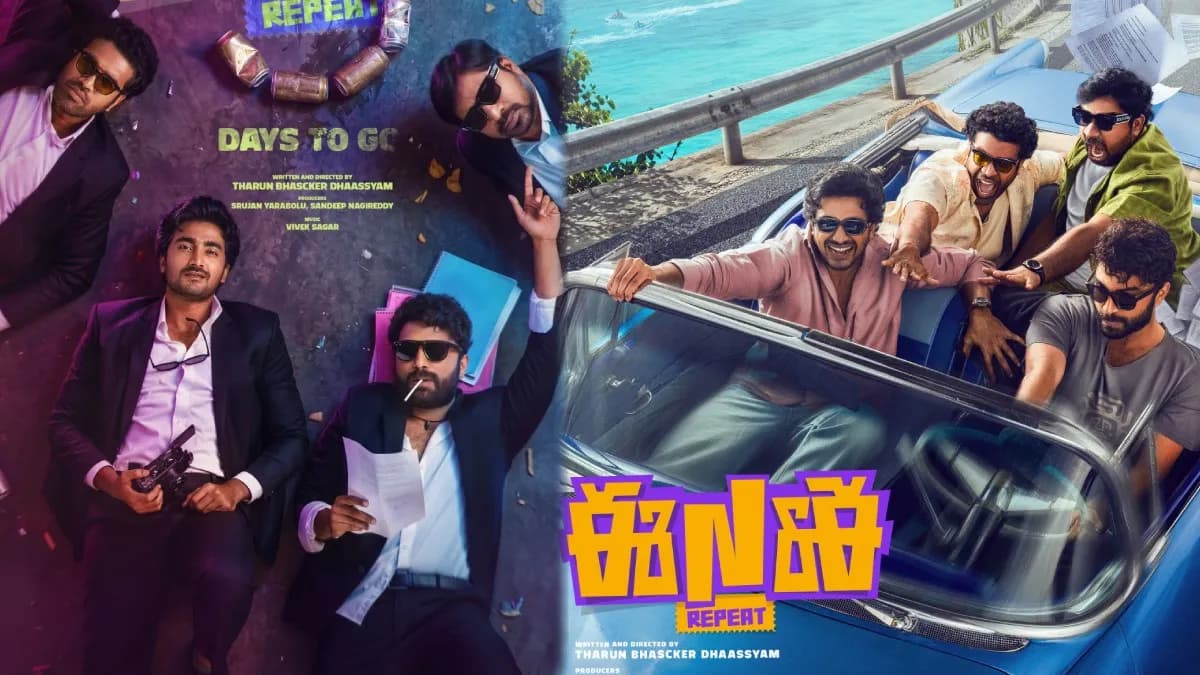
The Vishwak Sen-starrer ENE 2 has become one of the more closely tracked Telugu releases on the business side, with trade circles weighing how the sequel's wider scale will translate into returns. No officially certified budget, pre-release deal figures or break-even numbers have been published for the film, so any precise arithmetic circulating online should be treated with caution. What can be said with confidence is that a sequel to a well-liked title arrives with higher costs and higher expectations in equal measure, and that combination shapes almost every conversation about its commercial prospects.
The first ENE film earned attention for its concept-driven approach and the space it gave Vishwak Sen to carry a narrative largely on his shoulders. A follow-up naturally demands more: more locations, more production design, more time in post-production. Each of those line items pushes the cost base upward. The question distributors and exhibitors are asking is not whether ENE 2 cost more than the original, but whether the increase is proportionate to the audience pull the franchise has demonstrated so far.
Where the Money Goes on a Film Like This
In the Telugu market, a movie's overall budget is rarely a single clean figure. It is a stack of components: the fee paid to the lead actor, the amounts committed to the director and technical crew, production and location costs, visual effects and other post-production work, publicity and release expenditure, and the interest and overheads that accumulate while the film sits in the pipeline.
For a star-led sequel, the actor's remuneration and the visual effects budget are typically the two heaviest blocks. Vishwak Sen has built a following through a mix of commercial and experimental choices, and his price has moved in step with that following. On the technical side, a sequel that wants to look bigger than its predecessor almost always spends more on effects and design. Marketing is the third variable and the hardest to predict, because the campaign for a sequel generally starts earlier and runs longer than for a standalone film.
None of these figures are public for ENE 2. Studios in the Telugu industry share such details rarely, and usually only well after a film's run has ended. Readers should be sceptical of precise numbers presented without attribution.
How Break-Even Is Actually Calculated
The break-even point is the revenue at which a film recovers its investment. In practice, the calculation is built on the share of ticket sales that flows back to the film's financiers rather than on gross collections. A portion of every ticket goes to the multiplex or single-screen owner, a portion goes to the state in the form of entertainment tax and other levies, and what remains is the distributor's share. That share, not the headline gross, is what services the budget.
Because the share percentage differs by territory and by language version, a film's break-even target is not one number but a set of them. The Telugu states account for the bulk of the recovery for most straight Telugu releases, with the Nizam region and the Andhra territories usually the largest contributors. Overseas markets, particularly North America, add a meaningful slice and often arrive earlier in the collection cycle. Satellite and digital rights provide a cushion negotiated before release, reducing the amount the theatrical run itself must recover.
For ENE 2, the honest answer to "what is the break-even target" is that it depends on the final cost and the terms of those pre-release deals, neither of which has been disclosed. Trade analysts will form their own working estimates once the film's release scale is confirmed, and those estimates will be revised repeatedly in the first week.
What to Watch Before Release
Three signals tend to matter more than leaked figures. The first is the number of screens and the pricing strategy in the Telugu states, which indicates how confident distributors are. The second is the volume of business done in the overseas market ahead of release, since a strong North America opening can materially change the recovery math. The third is the film's certification and runtime, which influence how many shows each screen can run per day and therefore the ceiling on early collections.
Until those details are confirmed, the most useful framing for ENE 2 is this: it is a sequel to a film that earned goodwill, fronted by an actor whose choices draw attention, and made on a scale that will require a genuinely wide audience rather than a niche one. Whether it clears its costs will depend less on the size of the budget than on how many people decide, in the first ten days, that the sequel was worth the ticket. That is the variable no business analysis can predict in advance.
Source: Filmibeat Telugu