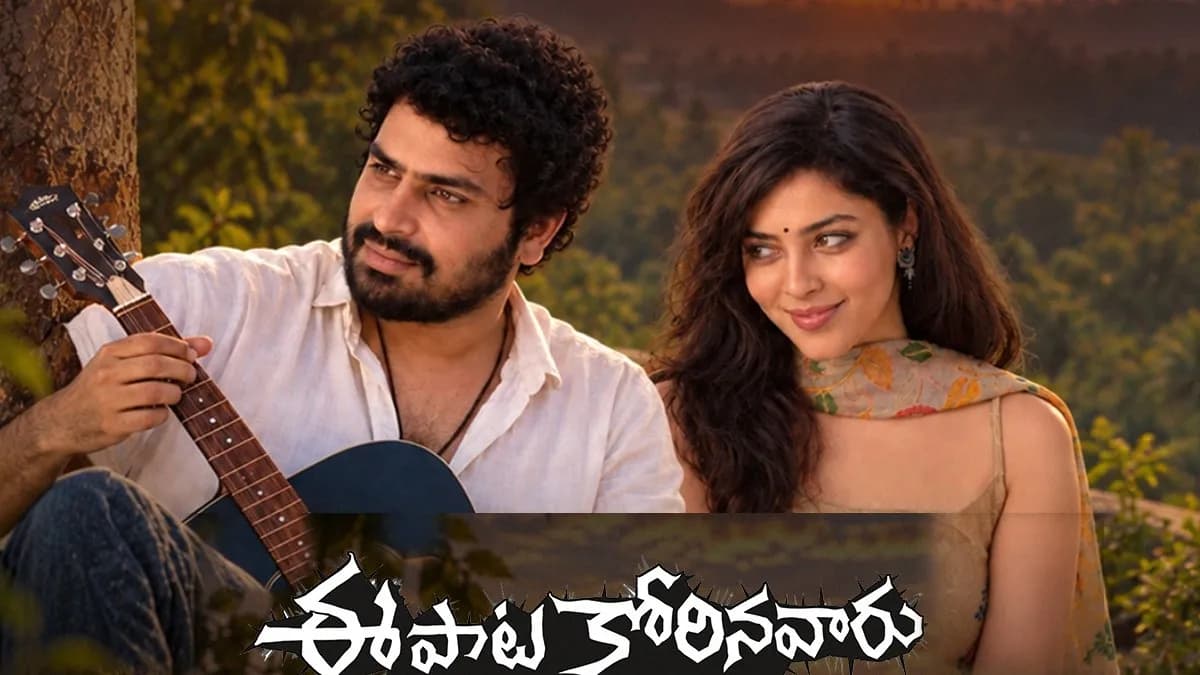
Telugu cinema's long-running love affair with the musical drama gets another entry this week with "Ee Paata Korinavaaru," a film whose very title - roughly, "those who asked for this song" - signals that music sits at the center of its emotional universe rather than decorating the edges. The movie arrives in theaters carrying the kind of word-of-mouth that musicals in the Telugu space tend to generate slowly: audiences who connect with its tunes first, and its story second. Whether that equation ultimately works in its favor is the central question hanging over the release.
The premise trades on a familiar but durable idea - a song that refuses to stay in the past, and the people who cannot let go of what it once meant to them. Without giving away the turns the narrative takes, the film positions its music not as background score but as a kind of character, one that carries memory, grief and reconciliation across its runtime. It is a structure that has served Telugu filmmakers well for decades, from the melodious dramas of the studio era to more recent attempts to fuse melody with contemporary storytelling.
What the film gets right, for the most part, is its commitment to that idea. The composers have clearly been given room to breathe, and the soundtrack is the element most likely to follow viewers home. Songs are staged with an awareness that the audience came for them, and the film rarely rushes past a musical moment to get to the next plot beat. That patience is a virtue in a genre that often treats songs as obstacles to be cleared.
Where the film stumbles is in the connective tissue between those highs. The writing leans on coincidence and emotional shorthand in places where a little more specificity would have deepened the stakes. Characters occasionally announce their feelings rather than inhabit them, and the middle stretch sags under the weight of subplots that never quite justify their screen time. It is the kind of unevenness that a stronger editorial hand might have smoothed without sacrificing the film's melodic soul.
Performances, though, hold the enterprise together. The leads bring sincerity to material that could easily tip into sentimentality, and the supporting cast - particularly the older performers - gives the film a lived-in texture that the screenplay does not always earn on its own. There is a warmth to the ensemble scenes that suggests genuine chemistry rather than assembled professionalism, and that warmth is what keeps the audience invested when the pacing drags.
Technically, the film is polished without being ostentatious. The photography favors natural light and unhurried frames, letting the musical sequences unfold without aggressive cutting. Production design situates the story in a recognizable, grounded world rather than a stylized one, which makes the more heightened musical moments land with greater force. The sound design deserves particular mention - in a film this dependent on music, the mix is clean and the vocals are never buried, a detail that matters more than most reviews acknowledge.
As for where it lands overall, "Ee Paata Korinavaaru" is best understood as a film of moments rather than a seamless whole. Its best sequences - and there are several - demonstrate real emotional intelligence about how music attaches itself to memory and identity. Its weaker passages remind you that ambition alone does not solve structural problems. Viewers who come primarily for the songs will likely leave satisfied; those hoping for a tightly constructed narrative around them may find the experience more uneven.
The film's commercial prospects will depend heavily on how its music performs in the weeks after release, which has always been the real engine for this kind of cinema. Telugu audiences have repeatedly shown that they will forgive a film its narrative indulgences if the melodies stay with them, and this one has at least a few that might. Whether that is enough to sustain a theatrical run in a crowded release calendar remains to be seen.
For now, "Ee Paata Korinavaaru" stands as a sincere, occasionally moving attempt to put music back at the heart of Telugu storytelling - imperfect, but made with evident love for the form. It is the sort of film that will find its audience not on opening weekend alone, but in the hummed melodies that linger long after the credits, which, for a movie built around a song, may be the most fitting verdict of all.
Source: Filmibeat Telugu