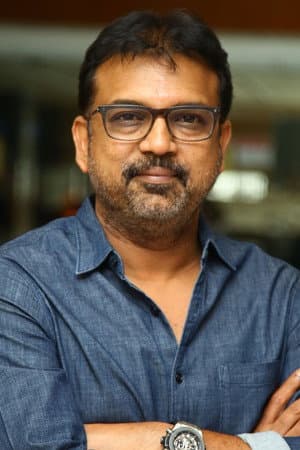
Koratala Siva: The Films And The Filmmaking traces a career built in two stages, first at the writing table and then behind the camera. He came to direction through writing, and that is the first thing to hold on to when reading his filmography. Before he directed a frame, he wrote dialogue and scripts. The films that carry his name as writer sit beside the ones he directed, one continuous body of work.
Three credits need explaining early, because they frame everything below. In Telugu cinema, the story credit belongs to the person who conceives the narrative. The screenplay credit goes to the person who shapes how that narrative is told on screen. The dialogue credit belongs to the person who writes what the characters actually say. Siva has held all three, often on the same film. The pattern of which credits he takes tells you what kind of filmmaker he is.
The writing years and the directing years
The early credits are as a writer rather than a director. Bhadra (2005) and Munna (2007) establish him first as a dialogue and script writer. That work trains a filmmaker in rhythm, in the sound of speech, and in how a line lands with an audience. Simha (2010) follows as a writer. Readers outside the region should treat these as the apprenticeship: the place where an ear for the language of Telugu cinema was built before it was applied to whole films.
Mirchi (2013) is the first film where he takes director, screenplay and story credit together. From that point the triple credit becomes his signature. Srimanthudu (2015) and Bharat Ane Nenu (2018) repeat it. Janatha Garage (2016) is credited as director, writer and screenplay rather than story, which is worth noting without over-reading.
What each contributed is visible in the premises. Mirchi is the film most closely associated with his name, the one that established him as a director. Srimanthudu takes a man who already has everything and sends him toward a village he adopts, turning privilege into obligation. Janatha Garage moves an environmental activist from Mumbai to Hyderabad and into a role he did not seek. Bharat Ane Nenu sits in the same register of responsibility carried by someone who could avoid it. Devara: Part 1 (2024) splits the figure in two, a warrior father and a mild-mannered son, and lets the son find his own path.
Acharya (2022) belongs in this list and earns its place honestly. A middle-aged former Naxalite turned social reformer takes on an Endowments Department over temple funds: a story about institutions and who guards them.
The Recurring Figure
Across these films the central character is rarely chasing something for himself. He arrives, or is pulled in, and takes on a burden that belongs to a place or a community. Srimanthudu's Harsha has wealth and looks for meaning. Janatha Garage's Anand takes over a garage and its obligations. Bharat Ane Nenu puts responsibility on a man who could have stayed clear of it. Devara: Part 1 hands the same question to a son.
The second constant is reform through confrontation. Temple funds, a village's condition, a community's welfare: the subject is almost always an institution that has stopped serving the people it exists for, and a protagonist who decides to make it answer. The third is the writing itself. Because he writes his own dialogue, the speeches in these films are not decoration. They are the argument, and they are usually delivered by someone explaining why he will not step back.
That combination, a reluctant central figure and an institution that must be confronted, connects the work more than any single genre label. The films change scale and setting. The question stays the same.
Why the Name Matters Beyond the Region
For a reader who follows Telugu cinema from outside Andhra Pradesh and Telangana, Koratala Siva is a useful entry point because his films are built on legible ideas. You do not need to know the industry to follow a man who adopts a village, or a reformer who takes on a department, or a son deciding what to do with his father's life. The premises travel. For background on the wider industry, the Telugu cinema overview and the Internet Movie Database entry are reasonable starting points.
His position is that of a director who works at scale with the industry's leading figures, and who arrives at that scale through writing. That combination is the reason the name is worth knowing: the films are large, but they are argued rather than merely staged. Ten titles in the confirmed filmography, four of them carrying director, story and screenplay together, and a run that begins in dialogue and ends in the two-part scale of Devara: Part 1. The through-line is the sentence, and the man who learned to write it before he learned to stage it.