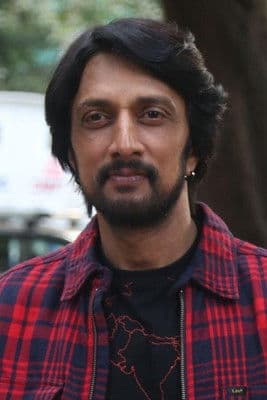
Sudeep Sanjeev, known across South India as Kichcha Sudeepa, built his standing in Kannada cinema long before Telugu audiences came to know him. His Telugu work is small in number and unusually wide in range. It runs from a fantasy comedy in which he plays the villain, through two epic historical productions, to a war drama and a brief guest appearance. What links these parts is not screen time but presence: he is the figure the story turns on, whether he carries the scene or gives it its obstacle. This piece traces Kichcha Sudeepa: A Career In Telugu Cinema through the five titles that define it.
A Kannada Name That Telugu Audiences Learned To Recognise
To understand how a Kannada performer becomes familiar to Telugu viewers, start with the term "pan Indian." A pan Indian release is one planned for several language markets at once, rather than one region only. A performer with pan Indian appeal is therefore someone whose face travels ahead of him, recognised in theatres far from the industry that trained him. Sudeep is the clearest example of this in the Telugu market: a Kannada name that Telugu audiences learned to recognise without his career ever relocating.
The Telugu filmography is short enough to watch in an evening, yet it stretches across genres and eras of production. A fantasy comedy, two epic historical productions, a war drama, and a guest appearance do not obviously belong together. What holds them is a single principle. In every one, Sudeep is the figure the story turns on. Sometimes he is the engine. Sometimes he is the counterweight. He is never background.
For readers outside the region, this matters because Telugu cinema has a long habit of borrowing recognised performers from neighbouring industries for decisive parts. Sudeep's Telugu work shows how that borrowing works at its best: not as decoration, but as structure. Each appearance changes the temperature of the film around it.
The Telugu Films And What Each One Added
Eega (2012): The Villain As The Engine
In this fantasy comedy, a flower decorator named Nani falls for his neighbour Bindhu, and their romance is interrupted when he crosses Sudeep, a ruthless and powerful businessman. Sudeep plays the businessman, and the film's comedy and tension both depend on his reactions. A villain in this mould is not a distant threat but a constant presence, and the humour grows from the gap between his power and his frustration. For a Telugu audience, this is the performance that showed how naturally he could hold a comic villain role: a large, imposing figure who is also, deliberately, ridiculous.
The Baahubali Films (2015 and 2025): Aslam Khan Across Two Releases
In Baahubali: The Beginning, a foundling named Shivudu grows up in a small village with exceptional gifts, meets the warrior princess Avanthika, and sets out to rescue her queen, held captive for 25 years. He learns his own origins along the way. Sudeep appears as Aslam Khan. Baahubali: The Epic returns to the same world: a child raised by a tribal couple near a waterfall is drawn beyond the cliffs to Mahishmati, a kingdom ruled by a cruel tyrant and shaped by rebellion, betrayal and a forgotten prince. Sudeep again plays Aslam Khan. "Retelling" here means coming back to the same story from a different angle, rather than a straight continuation. That makes him one of the few performers whose Telugu work spans the original film and its later retelling.
Sye Raa Narasimha Reddy (2019): Avukuraju In A Period Drama
At Gwalior Fort during the Indian Rebellion of 1857, Lakshmibai, Rani of Jhansi, lifts her men's spirits by telling the story of Uyyalawada Narasimha Reddy, a Telugu chieftain who took up arms in 1846 against the actions of the East India Company and its forces. Sudeep plays Avukuraju, placing him inside a large historical cast where the drama comes from the collective cause rather than any single figure.
Action 3D (2013): The Guest Appearance
He appears only in a guest appearance. Such a brief part is worth noting precisely because it shows how the industry uses a familiar name: a short turn that borrows his recognition for a scene without building the story around him.
The Roles He Returns To, And Why The Name Matters
Two patterns run through these five titles. The first is the antagonist or counterweight: in Eega he is the obstacle the story pushes against, and in the Baahubali films his Aslam Khan belongs to the world surrounding the central struggle. The second is the historical ensemble, seen in Sye Raa Narasimha Reddy, where he is one part of a large political conflict. Both suit a performer whose face registers authority quickly, without needing long introductions.