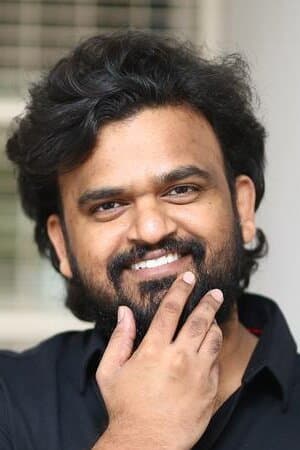
K.S. Ravindra is a director and screenwriter in Telugu cinema, the film industry centred in Hyderabad that produces films in the Telugu language. Outside the region, the industry's output is often known simply as Tollywood, and readers who follow it from a distance tend to meet its films through their lead performers. The names behind the camera take longer to learn. This is a body of work that rewards the effort. Much of what makes a mainstream Telugu film click is settled at the writing table long before anyone stands in front of a camera.
The writing credit here is not a side interest. In this industry a director very often also writes, and Ravindra's path followed that pattern. He completed his schooling at Bhashyam High School in Guntur, then worked in the direction department of Aadinarayana's film Political Rowdy. That department is the standard apprenticeship route: aspiring filmmakers spend years on set handling the small logistics of production before they are trusted with their own material. From there he moved into screenwriting, with credits on Don Seenu, Mr. Perfect and Bodyguard, and story work on Balupu. Several of those scripts were written alongside Kona Venkat, a partnership that ran across multiple films. The directing career grew out of that writing, not the other way round. Knowing it explains nearly everything that follows.
The Films and What Each One Added
The 2014 to 2019 run is where the filmmaking takes shape. Power in 2014 put Ravindra on a two-role premise built around a lookalike: a corrupt officer in Kolkata and a young man in Hyderabad desperate to join the police, with one recruited to pose as the other. Sardaar Gabbar Singh in 2016 continued in the large-scale action mode, a film that leans on scale and a commanding central presence. Jai Lava Kusa in 2017 is the clearest showcase of the writing instinct: triplets separated in childhood, one of them a criminal, and a story that turns on why the villain needs his brothers at all. Venky Mama in 2019 shifts register entirely. This is a family drama about a rice-mill owner who raises his nephew as his own son after the boy's parents die, and the forces that try to pull the two apart. It is useful proof that the filmmaking is not only action.
The later stretch shows the same machinery at larger scale. Waltair Veerayya in 2023, as director and writer, is a smuggling story that moves across countries and hinges on a hidden past, as a hired operative confronts a gang lord and the history they share. Daaku Maharaaj in 2025 credits him as director and for the story, and he also appears in a cameo in a song from the film. That cameo is a light closing note on how visible the director has become, not the point of the section. One further credit sits between the two groups: Pantham in 2018, where he is credited for the screenplay, a reminder that the writing work never stopped while the directing work grew.
The Patterns He Returns To, and Why the Name Matters
Pull the threads and a set of recurring devices appears. Doubles and mistaken identity, as in Power. Brothers and separated families, as in Jai Lava Kusa and Venky Mama. A hero with a concealed history, as in Waltair Veerayya. And a villain whose motive drives the plot rather than merely obstructing it. Running underneath all of them is a screenwriting habit: withhold a past, let the present run on incomplete information, then pay the withheld material off late, when the audience has stopped expecting it. That is craft, and it is repeatable.
Note also the split working life. He writes for other directors and directs his own material, and that division says something about how the industry uses a trusted writer. A screenplay credit from a known hand is a form of insurance for a producer, and Ravindra has been that hand often enough to be one. It also means his films arrive with a structure already tested on paper. That is why they tend to hold together around a single turn.
His placement is in the commercial mainstream, in films built around lead performers. That is where a large share of Telugu cinema's audience lives, so the mainstream is not a lesser address. For a reader outside the region, the reason to know the name is that this is the craft layer underneath the spectacle: the person shaping the twists and the family logic that the big films run on. The body of work is the argument, and it makes that argument clearly enough on its own.